
Your organisation runs sophisticated marketing campaigns across multiple channels.
But here’s the uncomfortable question: how much of your customer journey data are you actually owning versus lending to third parties?
For larger enterprises, traditional client-side tracking isn’t just inconvenient.
It represents material data loss, regulatory risk, and competitive disadvantage.
Ad blockers affect 30-40% of enterprise traffic.
Browser privacy features cripple attribution windows to just seven days.
With POPIA actively enforced, uncontrolled data collection carries significant legal exposure.
GTM Server-side tracking is not merely an accuracy fix. It is a data governance strategy.
By owning your data pipeline, your organisation regains control, ensures compliance, and builds durable first-party data assets for a cookieless world.
This guide provides your roadmap.
What is Server-Side Tracking? (Enterprise View)
For enterprise organisations, the shift to server-side tracking is fundamentally about data ownership.
Traditional client-side GTM tracking forces your website to share customer data directly with third-party platforms like Google and Facebook.
You might find this interesting: GA4 Alone Is Not Enough: Why Your Business Needs Google Tag Manager
Server-side tracking flips this model entirely.
Client-Side vs. Server-Side: The Strategic Difference
| Aspect | Client-Side (Traditional) | Server-Side (Enterprise) |
| Data Path | Browser → Google/Facebook directly | Browser → Your Server → Google/Facebook |
| Cookie Status | Third-party (often blocked) | First-party (respected by browsers) |
| Data Ownership | Shared with platforms | You control before sharing |
| Compliance Control | Limited audit trail | Complete governance |
How Google Tag Manager Server-Side Tracking Works
Google Tag Manager enables this architecture through its server container feature.
Here is the simplified data flow:
- User interacts with your website – events fire to your own server container.
- Your server validates the data, applies consent rules, strips sensitive information.
- Cleaned data forwards to GA4, Google Ads, Facebook CAPI, and other destinations.
- Your custom domain (analytics.yourcompany.co.za) sets first-party cookies, bypassing browser restrictions.
GTM server-side tracking transforms your organisation from a passive data supplier to an active data controller.
You decide what data leaves your infrastructure, where it goes, and under what conditions.
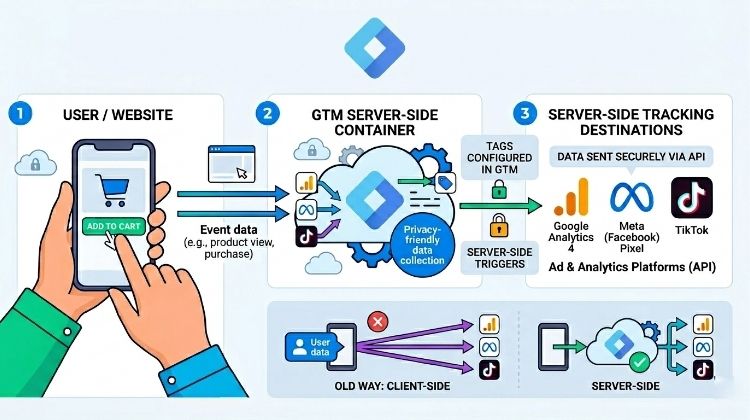
The Strategic Shift
“Instead of your customers’ browsers talking directly to Google (where blockers and privacy features interfere), they talk to your server first. You then selectively share what you choose, when you choose.”
Why Enterprises Must Consider Server-Side Tracking
For South African enterprises, the question is no longer if you should explore server-side tracking, but when.
The forces reshaping digital analytics—privacy regulations, browser restrictions, and the death of third-party cookies—are not slowing down.
Google Tag Manager server-side capabilities offer a strategic response to each of these challenges.
1. Regain Lost Conversion Data at Scale
The financial impact of data loss is substantial.
Ad blockers now affect 30-40% of enterprise website traffic.
Safari’s Intelligent Tracking Prevention (ITP) limits client-side cookies to just seven days.
For B2B enterprises with 30-90 day sales cycles, this makes accurate attribution nearly impossible.
GTM server-side tracking recovers most of this lost data by:
- Bypassing ad blockers entirely (data flows server-to-server).
- Extending cookie lifetimes to up to two years.
- Preserving UTM parameters and campaign data across the full customer journey.
The Financial Case: An organisation spending R500k monthly on digital advertising with 30% data loss is effectively wasting R150k on unmeasurable spend.
Server-side tracking typically recovers 25-35% of that lost data, directly improving ROAS calculations and budget allocation.
2. Achieve POPIA Compliance with Confidence
The Protection of Personal Information Act (POPIA) requires organisations to demonstrate lawful processing, data minimisation, and subject rights.
Traditional client-side tracking makes this difficult—you have limited control over what data Google collects or how long it’s retained.
Google Tag Manager server-side containers provide compliance tools that client-side tracking cannot match:
- Consent Orchestration: Apply user consent preferences at the server level. Data only flows to analytics platforms for users who have explicitly opted in.
- Data Minimisation: Strip or hash PII (email addresses, phone numbers, ID numbers) before sending any data to third parties.
- IP Anonymisation: Anonymise IP addresses at the server level, never sending raw IPs to GA4.
- Audit Trail: Complete, queryable logs of what data was sent, to which platform, and under what consent conditions.
“When the regulator asks how you protect customer data, server-side tracking gives you documented, defensible answers.”
3. Own Your First-Party Data Asset
Third-party cookies are disappearing. Google will fully deprecate them in Chrome. Organisations without first-party data strategies will lose targeting and measurement capabilities entirely.
GTM server-side tracking becomes your data ingestion layer—the foundation of a Customer Data Platform (CDP):
- Collect consented, first-party data directly from your digital properties.
- Enrich and clean data before it enters your analytics stack.
- Route clean data to GA4, your CDP, your data warehouse, and your marketing platforms.
Competitive Advantage: While competitors scramble to adapt to a cookieless world, your organisation will already own the infrastructure for durable, first-party customer intelligence.
4. Consolidate Multiple Tracking Setups
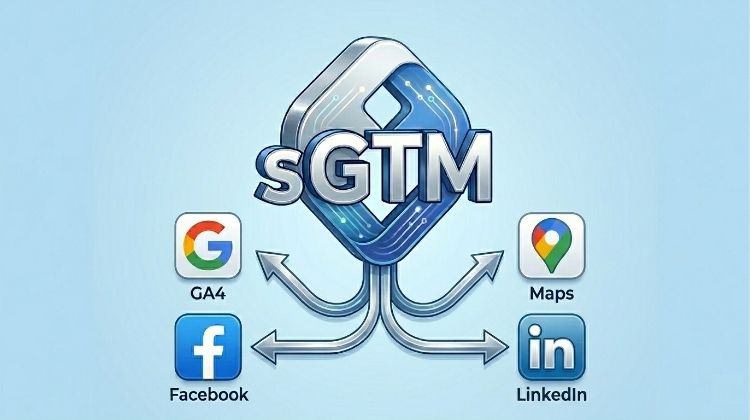
Enterprises typically manage separate tracking implementations for GA4, Google Ads, Facebook CAPI, LinkedIn, TikTok, and their CDP.
Each platform requires configuration, testing, and maintenance.
Google Tag Manager server-side tracking consolidates this complexity:
- Send data once to your server container.
- Your server distributes to all destination platforms.
- One consent layer governs all outbound data.
- One set of transformation rules applies universally.
Operational Efficiency: One implementation instead of six. One debugging process instead of six. One compliance framework instead of six.
The Hybrid Approach – A Pragmatic Enterprise Path
Enterprise organisations do not need to migrate everything at once.
A phased, hybrid approach to GTM server-side tracking reduces risk, manages costs, and delivers value incrementally.
Start small, prove the ROI, then expand.
Phased Implementation Strategy
| Phase | Focus | Timeline | Expected Value |
| Phase 1 | Most valuable conversion (purchase, quote request) | 2-4 weeks | Quick win, visible ROI |
| Phase 2 | Google Ads + Facebook CAPI server-side | 4-6 weeks | Attribution improvement |
| Phase 3 | Remaining events + data enrichment | 6-8 weeks | Complete data governance |
| Phase 4 | Decommission client-side tags | 8-12 weeks | Full first-party ownership |
Consent Mode v2 – The Critical Companion
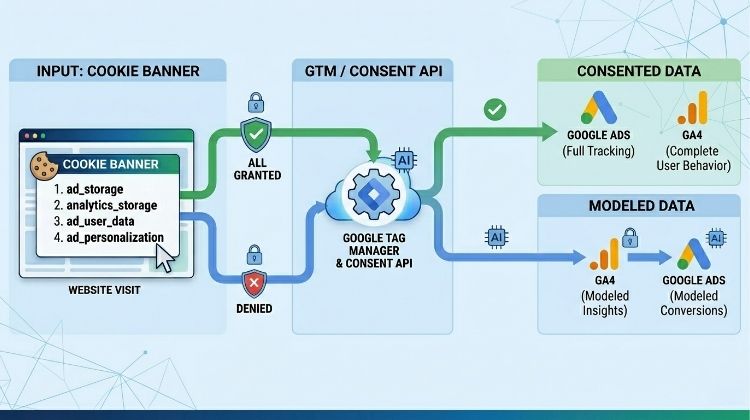
Google Tag Manager server-side tracking works best alongside Consent Mode v2.
This combination creates a complete consent management system:
- Client-side: Your cookie banner captures user consent preferences.
- Server-side: Your GTM server container applies those preferences before forwarding data.
- Result: An auditable, defensible consent framework for POPIA compliance.
For South African enterprises serving EU customers, Consent Mode v2 is now mandatory for Google Ads.
You might find this interesting: Respect Privacy & Keep Your Data with Consent Mode V2
The Server-Side CDP Alternative
For organisations with larger budgets (R20k+ monthly), enterprise CDPs like Segment or mParticle offer GTM server-side tracking features plus:
- Native integrations with hundreds of marketing tools.
- Built-in identity resolution across devices.
- Advanced data governance and role-based access.
- Dedicated support and SLAs.
Cloudflare offers an alternative approach through its Zaraz product.
Cloudflare Zaraz runs third-party tools on Cloudflare’s edge network, not your server.
Key advantages include:
- No cloud hosting costs (included with Cloudflare plans).
- Faster load times (edge execution).
- Built-in consent management.
- Simpler setup than full GTM server container.
Recommendation: Start with Google Tag Manager server-side for Phase 1-2.
For organisations already using Cloudflare, evaluate Zaraz as a lighter-weight alternative.
If your governance requirements grow significantly, migrate to an enterprise CDP later.
The foundational infrastructure remains valuable regardless of your chosen path.
Decision Framework To Use GTM Server Side Tracking For Your SA Enterprise
Determining whether GTM server-side tracking is right for your organisation requires honest assessment.
Use this framework to evaluate your readiness and build a business case.
The Enterprise Readiness Checklist
Score your organisation against these criteria. Each “yes” is one point.
- Ad Spend Threshold: Monthly digital ad spend exceeds R200k.
- Compliance Requirements: Subject to POPIA, GDPR, or other privacy regulations.
- Technical Resources: In-house development or IT resources available for implementation.
- Data Quality Issues: Significant discrepancies between GA4 and internal sales data (20%+ gap).
- First-Party Strategy: Building a first-party data asset or CDP is a strategic priority.
- Sales Cycle Length: Customer journey exceeds 14 days.
- Channel Complexity: Advertising across 3+ platforms (Google, Meta, LinkedIn, TikTok, etc.)
Scoring Guide:
- 5-7 yes: Strong business case. Prioritise Google Tag Manager server-side implementation within 3-6 months.
- 3-4 yes: Pilot recommended. Start with Phase 1 (single conversion) to prove ROI.
- 0-2 yes: Client-side tracking likely sufficient for now. Reassess annually.
Building the Business Case
Present this calculation to stakeholders:
ROI Formula:
- Current monthly ad spend: R_______
- Estimated data loss (25-40%): × _______
- Wasted spend: = R_______
- Monthly server-side investment (R4k-R15k): − R_______
- Net monthly recovery: = R_______
Example: R500k ad spend × 30% data loss = R150k waste. R150k − R10k server-side cost = R140k net monthly recovery.
This framework transforms GTM server-side tracking from a technical project into a measurable financial investment with clear returns.

Conclusion
The era of reliable client-side tracking is ending. Browser restrictions, ad blockers, and privacy regulations are fundamentally changing how digital data can be collected.
For South African enterprises, GTM server-side tracking is not experimental technology—it is becoming the new standard.
Organisations that adopt server-side tracking now will benefit from cleaner data, stronger POPIA compliance, and durable first-party data assets.
Those who delay will face widening data gaps, increasing attribution blindness, and growing competitive disadvantage.
You do not need to migrate everything at once.
Start with a pilot focused on your most valuable conversion. Prove the ROI. Then expand.
Your next step: Run a simple audit this week. Compare your GA4 conversions against your CRM or sales system for the past 90 days.
Calculate your data loss percentage. That number is your business case for server-side tracking.
Ready to explore Google Tag Manager server-side tracking for your organisation? Book a free discovery call to discuss your specific needs and timeline.